Auditing ATM Withdrawals That Vanish From Your Budget
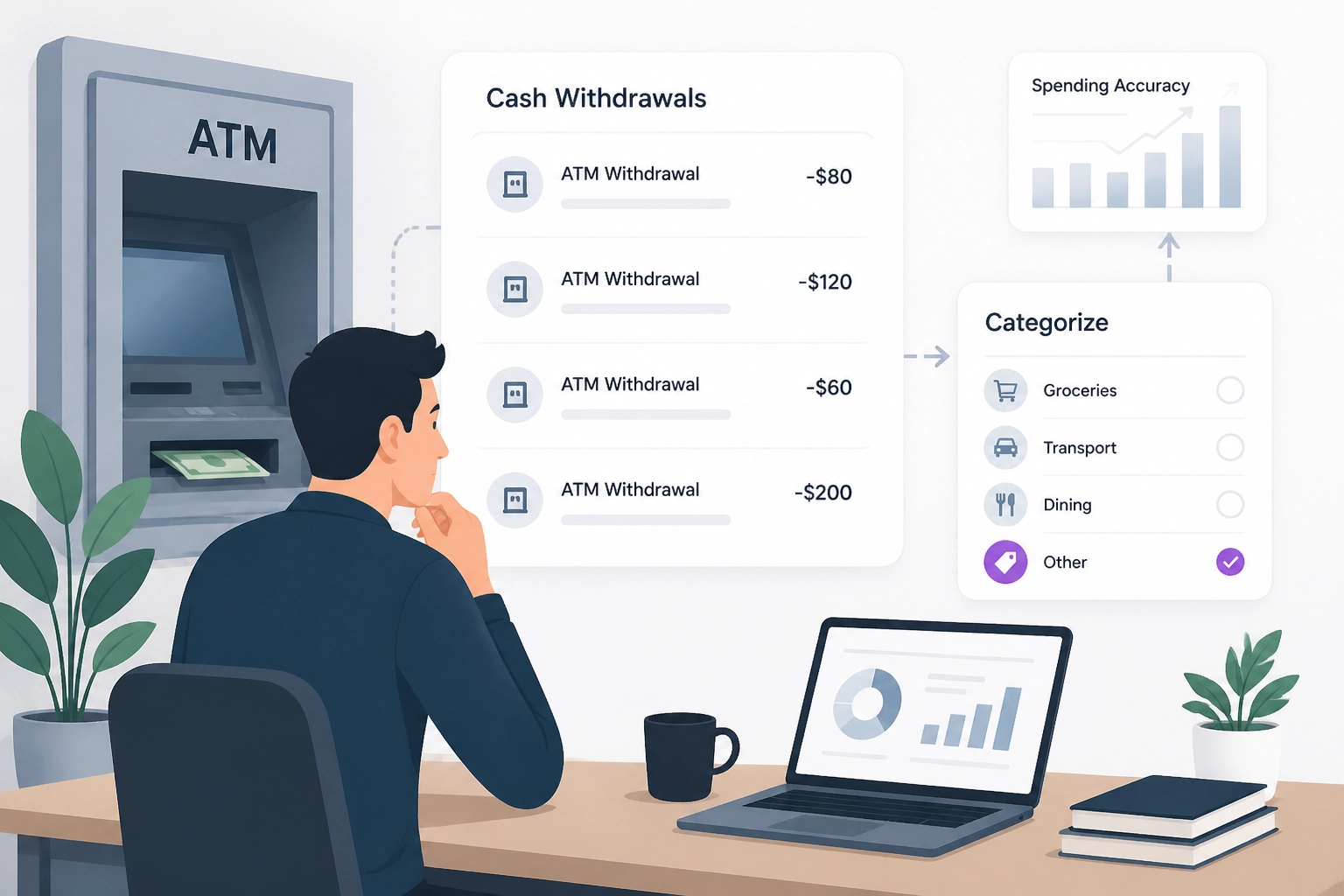
ATM withdrawals hide real spending. Learn how to audit every cash line, tag a fortnight by purpose, and build an allocation rule that fixes your budget.
Your budget says you spent $40 on groceries, but your statement shows a $40 ATM withdrawal. An ATM withdrawal is one line on a statement and dozens of small decisions in real life: coffee, a market stall, a split bill, a tip. If your spend analysis treats that cash line as a finished transaction, discretionary spending looks smaller than it is, and every category gets a quiet boost. Cash still matters. The Federal Reserve's 2026 Diary report says cash accounted for about six payments per month in 2025, or 14% of total payments, making it the third most-used instrument. Four in five consumers used cash in the last 30 days, and 90% plan to keep using it. Cash is hard to trace and costly to replenish, so it becomes an invisible leak.
This how-to walks you through fixing that: why cash slips past spend analysis, prepping the audit, listing every cash acquisition instead of only ATM withdrawals, tagging a fortnight by purpose, turning those tags into an allocation rule, folding it into your monthly budget, and keeping cash visible afterward. By the end, the cash line will finally account for itself.
Why Cash Slips Past Your Spend Analysis
Cash has not gone away, and it is not a shrinking edge case: the reason it slips past a spend analysis is mechanical.
The blind spot is mechanical. A cash withdrawal moves money from your current account into your pocket. That makes it a transfer, not an expense. Book it as a finished transaction and the actual purchases never get a row. The error then runs in one direction: unallocated cash understates discretionary spending and quietly flatters groceries, dining, coffee and personal care. The money was spent; the categories just never saw it.
Traceability is a documented problem, not a personal failing. A Federal Reserve Bank of San Francisco note on who holds cash observes that cash transactions may be difficult to trace or remember for record keeping and budgeting. It also notes that replenishing cash through ATMs or other means costs time, labour and possibly transaction fees. Treat that as a conceptual point, since the note rests on 2012 data.
Match the effort to the exposure. Consumers averaged 47 payments a month in 2025, with cards at roughly two thirds by number. Cash is a minority of statement rows but a disproportionate share of the unexplained ones. That makes the audit worthwhile: asking better budget questions starts with lines you cannot see, and transaction-level analysis shows the gap a pie chart hides.

Before You Start: What the Cash Audit Needs
The fix starts with a small pile of evidence rather than a spreadsheet overhaul. Gather three months of checking account and savings statements wherever cash lines appear, in whatever export your bank offers. That gives the withdrawals some context before you tag anything.
Pick two consecutive ordinary weeks to tag. Avoid holiday weeks and payday spikes, because a skewed fortnight will produce a rule that quietly misallocates every month after it.
For the tagging surface, three columns are enough: date, amount and purpose. A spreadsheet, notes app or paper all work. Reuse the categories you already run on your budget so the results slot straight in, which is the same logic behind building a budget from real spending.
Jog recall with receipts, delivery app history, calendar entries and texts. Tag as you go rather than rebuilding the fortnight at the end, and mark anything genuinely forgotten as unknown instead of guessing.
Finally, note cash that never came from your bank, such as gifts or money from family. Record these separately, or the audit will look complete while quietly missing purchases.
With your statements gathered and an ordinary fortnight chosen, you are ready to list every cash acquisition.
Step 1: List Every Cash Acquisition, Not Only ATM Withdrawals
With your statements gathered and an ordinary fortnight chosen, the first job is to find every route cash took into your hands, not just the obvious ATM line.
Sweep each statement for:
ATM withdrawals
Cash back at checkout
Teller withdrawals
Transfers to a payment app you later withdraw
Checks you cashed
Filing all of these under one label is what lets a spend analysis treat them as a finished transaction. If a line is ambiguous, this guide to reading a bank statement helps separate a withdrawal from a transfer.
Then add the cash that never touched a bank. A 2017 Diary analysis found about 21 percent of respondents got cash over a three-day period, mostly from family and friends, with ATMs among other methods. An ATM-only audit leaves those infusions spent with no record at all.
Build one running list with date, amount and source, then total it. Three months of a $60 weekly withdrawal is $780 your current categories never explain, and seeing that figure is usually what makes the rest worthwhile.
Keep withdrawal fees out of the cash total. They belong with bank charges, so they do not inflate the pool you are about to split across categories.
Finally, read the total for its pattern. A fixed weekly withdrawal, erratic round-number top-ups and one large seasonal withdrawal each need a different allocation rule.
Step 2: Tag a Fortnight of Cash by Purpose
With your list of cash acquisitions in one place, the next job is working out what each one actually paid for. Tag by purpose, not by vendor. Groceries, transport, eating out, kids' school costs, tips and small cash are purposes you can carry straight into the budget; a list of shop names tells you nothing you can allocate.
Here is how the mechanics work. Say you pull out $60 every Friday. Over a tagged fortnight, $45 covers two grocery runs, $20 goes to a farmers' market, $15 to personal care, $10 to cash tips, and $30 stays in your wallet. That single $120 withdrawal becomes four named categories plus cash still unspent. It is an illustration, not a real customer record.
Pay closest attention to what cash bought that a card could also have bought: coffee, lunches, parking. Those are exactly the rows a card-based spend analysis is missing. Record leftover cash as still unspent, never as zero, because carried cash gets spent in a later fortnight and booking it as spent now guarantees it is counted twice.
Finally, capture purposes at the point of purchase for at least the first week, and keep the window short. A fortnight is long enough to reveal a pattern and short enough that recall stays honest, which is the whole point of picking it. From there, a budget-first workflow takes the tagged figures through to limits that stick.
Step 3: Turn Those Tags Into an Allocation Rule
Once your fortnight is tagged, the list still needs a rule. Start with the share of cash you actually spent. If $120 is withdrawn and $90 has a purpose, groceries at $65 are about 72% of tagged spending, personal care at $15 is about 17% and tips at $10 about 11%. Round to whole percentages you can apply without a calculator.
Then choose a rule shape that fits your withdrawal pattern. A flat split suits regular, similar withdrawals; purpose-first budgeting suits lumpy cash, where you assign each withdrawal before you spend it. This is a suggested method, not an accepted industry standard, so pick the version you will actually run.
Test the rule against the second fortnight or a second month before committing. If one category is off by more than a few percentage points, adjust the rule rather than editing the tags to fit. Edit the tags and it stops being a rule.
Next, decide what happens to unspent cash. Either accept a fixed float allowance as always unallocated, or roll carried cash into the next fortnight. Write down which convention you chose, because mixing the two is how double counting creeps back in.
Finally, date the rule and store it where your monthly review can see it. A split derived in a quiet summer fortnight will not survive a December of gifts, travel and school holidays, and an undated rule hides that drift. With the rule in place, your budgeting tips for real spending can do more than tidy categories.
Step 4: Fold the Rule Back Into the Monthly Budget
With the rule dated and stored, give it a home in the budget you actually review. Add one line called cash allocated and split it by your Step 3 percentages, so grocery, dining, transport and personal care totals reflect what genuinely happened rather than what the card statement saw. If the rule says 72/17/11 across $240 of monthly withdrawals, matching the split from Step 3, those categories gain $172.80, $40.80 and $26.40.
Then reclassify the withdrawal itself. It is a transfer into the cash pool, not an expense, so the spending now sits in the categories. Nothing is counted twice, and nothing quietly disappears from the totals.
Compare the new figures against the card-only version. Discretionary categories should rise, any cash or miscellaneous bucket should fall toward zero, and that gap is the size of the leak you were carrying. It is the same logic behind this zero-based budgeting walkthrough: every dollar needs a job, including the ones you draw as cash.
Reconcile at month end. Cash on hand at the start, plus acquisitions, minus tagged spending, should equal cash on hand at the end. Whatever difference remains is the amount still hiding, and it tells you whether the rule needs tightening.
Lastly, schedule the revisit for next quarter, or sooner if your withdrawal frequency, income or household routine changes. The rule is only as good as the fortnight it came from.
Tips for Keeping Cash Spending Visible
Once your rule is set, a few habits keep cash visible between audits. Keep cash as a tool if it works for you. If envelopes or a weekly cash allowance keep you on plan, allocate those withdrawals rather than abandoning the habit.
Match the audit’s length to your cash use. Consumers aged 55 and over made about 10 cash payments a month, versus two for ages 18 to 24, and rural residents averaged nine versus six for comparable non-rural consumers. A light cash user can audit one month; a heavy user gains from a full quarter of tagging.
Income changes the payoff. In 2024, households earning under $50,000 used cash for 28% of payments, versus 13% for those above $50,000, so lower-income households carry a bigger cash share and earn back the effort faster.
Keep the out-of-category float small and known. Average on-person cash available for spending was $74 in 2023, a useful benchmark for how much you leave outside your allocated pool.
If you use a statement tool such as StatementToBudget.com, which converts uploaded PDF, CSV, XLS or OFX statements into categorised budget insights, treat its cash lines as unallocated inputs that still need a rule like this one applied on top. For broader habits, see these tips that fit your statement.
Conclusion: Making the Cash Line Account for Itself
The tips above keep the audit honest while you run it. The payoff comes from one lasting change: deciding what that cash line means in your budget.
Stop treating a withdrawal as a finished expense. It is a transfer into an unallocated cash pool, and until you allocate it, your categories describe card habits, not your life.
Tag one ordinary fortnight by purpose, turn those tags into percentages you can defend, and test them against a second fortnight before trusting them. Then fold the rule into the monthly budget as a single cash allocated line split by those percentages, and reclassify the withdrawal as a transfer so nothing is counted twice.
Reconcile cash on hand at month end: opening cash plus acquisitions minus tagged spending should equal closing cash. Revisit the rule each quarter, or sooner if your routine shifts.
Once leftover cash has a place to sit, the flattery stops. Grocery, dining and transport totals start reflecting real decisions, and the budget finally adds up to the month you actually lived.