How to Build a Personal Budget From Scratch (Without Guessing Your Spending)
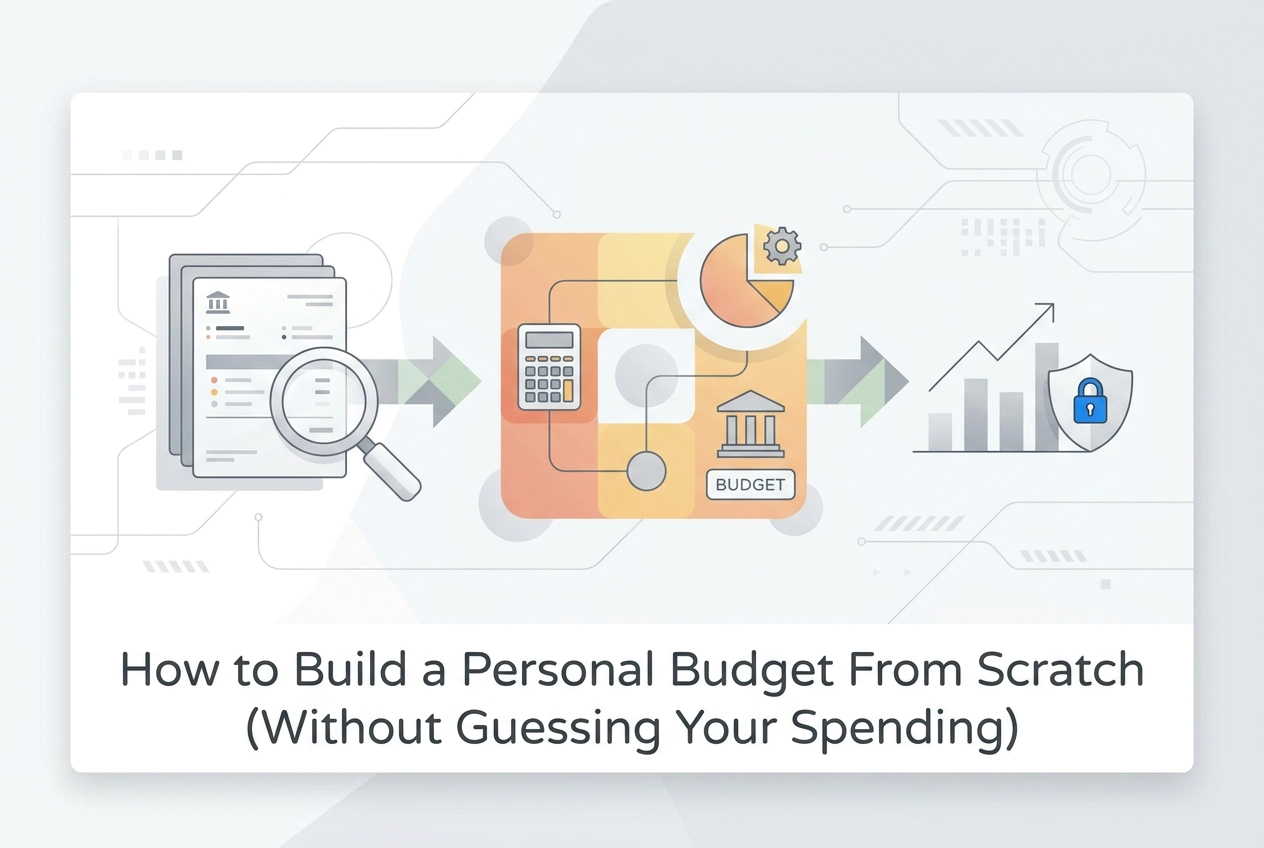
Stop guessing your spending categories. Learn how to use your real bank statement data to build a personal budget that's accurate and sustainable.
Most people start a personal budget the same way: they sit down with a blank spreadsheet, try to remember how much they spend on groceries, take a rough guess at their utility bills, and hope for the best. A few weeks later, the numbers don't add up and the whole thing gets abandoned. Sound familiar?
Here's the thing. You don't need to guess. Every pound you've spent in the last three months is already sitting in your bank statement, waiting to be read. That's real data, not estimates, and it changes everything about how you build a budget that actually works.
This guide is going to walk you through a smarter way to create a personal budget from scratch. You'll start by pulling the actual numbers from your bank statements, then organise your transactions, map them to spending categories, and use all of that to write a budget grounded in reality rather than guesswork. No assumptions, no vague estimates. Just your real spending history turned into a plan you can follow. By the end, you'll have a budget built on facts, and that makes it far easier to stick to.
Why Guessing Your Spending Never Works
Ask most people what they spend on eating out each month and they will give you a number. Ask their bank statement the same question and you will almost always get a higher one. Irregular purchases, habitual small spends, and forgotten subscriptions blur together in memory, making self-reported estimates reliably optimistic. Research into UK household spending patterns repeatedly finds that what people recall spending and what they actually spend in categories like transport, takeaways, and subscriptions can differ sharply.
The real damage happens in month one. You build a budget on estimated figures, the actual transactions come in higher, and the whole thing feels broken before it has started. Most people do not revise the budget; they abandon it. The false baseline becomes the reason budgeting "never works for me."
This creates a recurring friction that research into where money actually goes confirms: without a clear, accurate picture of past spending, every new budget attempt feels like starting from scratch, because it is.
The fix is not more careful guessing. It is skipping the guesswork entirely by starting with what your bank statement already recorded.
Your Bank Statement Is Already a Budget Planner
The answer to the guessing problem already exists in your online banking.
Every debit or credit card payment is logged automatically with the merchant name, exact amount, and date. No recall required. According to UK Finance, card payments accounted for 64% of all UK payments in 2024, with the total value hitting £1 trillion that year. For most households, the vast majority of real spending is already captured in bank records, with nothing left to reconstruct from memory.
A single month of statements gives you a snapshot. Three months gives you a pattern. Seasonal spikes, forgotten quarterly subscriptions, and irregular bills only become visible across a longer window. One month rarely tells the whole truth.
That is the shift this guide is built on. A personal budget planner grounded in real transactions is a description of how you actually live, not a forecast of how you imagine you spend. It does not require discipline to be accurate because the data already is.
If you want to understand exactly what your statement contains before building anything, learning how to read a bank statement and build a budget from it is a useful primer.
Before writing down a single budget number, look at what you have actually spent. The next step shows you how to get that data out.
Step 1: Retrieve Your Bank Statements
Log into your online banking and head to your account history or statements section. Most UK banks let you download statements directly from there, typically in PDF and often in CSV or OFX format depending on your provider. Download at least three months for every account you actively use, including your current account, any savings accounts you spend from, and your credit card. Spending rarely lives in one place, and missing an account means missing real costs.
Three months is the minimum, as established above, one month rarely tells the whole truth.
Once the files are downloaded, rename them immediately using a consistent format such as "Barclays-Current-March2025" before you do anything else. A folder full of files all named "Statement" will cost you time later.
If your bank only offers PDF exports, you do not need to copy transactions out by hand. StatementToBudget.com uses OCR to extract and structure the transaction data automatically from PDF, CSV, XLS, and OFX files, turning a tedious manual task into an instant upload.
Not sure whether your current account is the right fit for how you spend? Our guide to the best bank accounts UK: by category, use case and budgeting fit covers the options worth considering.
Step 2: Extract and Organise Your Transactions
With your statements downloaded, the next task is getting the data into a usable shape.
If your bank provides a CSV or XLS export, open it in a spreadsheet and check that three columns are present: date, description, and amount. If any of these are missing or merged, the file needs tidying before you proceed. You can see how this extraction process works if you want a clearer picture of what structured transaction data looks like.
If you only have PDFs, you have two options: copy each transaction row manually into a spreadsheet (time-consuming but free), or upload the file to a tool like StatementToBudget.com, which uses AI-driven OCR to handle the extraction automatically.
Once your data is in a spreadsheet, remove three types of entries that would distort your figures:
Internal transfers between your own accounts
Refunds already matched to an original purchase
Any correction entries posted by your bank
Next, sort all transactions chronologically across every account, so you have one unified timeline of outgoings covering the full three-month period.
That is all this step requires. Do not start grouping or labelling transactions yet; that comes next. Right now, the only goal is confirming that every real outgoing is visible and accounted for in one place.
Step 3: Map Your Transactions to Budget Categories
With your transactions organised, the next step is giving each one a home.
Use broad categories that reflect how you actually live: Housing, Transport, Food and Groceries, Eating Out and Takeaways, Utilities, Subscriptions, Personal Care, Entertainment, and Savings. These work better than textbook classifications because they match the decisions you make every day.
Go through each transaction and assign it based on the merchant name. Most are instant, but a few cryptic references will need a quick Google search or a check of the transaction date to jog your memory.
Pay close attention to subscriptions. Forgotten free trials, duplicate streaming services, and quiet price increases can push this category well above what you assumed you were paying. It is one of the most consistently underestimated lines in any personal budget.
If you want your personal budget planner to align with UK spending benchmarks, the ONS household expenditure classifications offer a useful reference point for sense-checking your figures against national averages.
For a deeper look at how to read, categorise, and budget from your bank statement, that guide covers the full transaction-to-budget process in detail.
If you are using StatementToBudget.com, this step happens automatically. The platform's AI categorises every transaction on upload, delivering a structured spending breakdown without any manual sorting required.
Step 4: Calculate Your Real Monthly Spending by Category
With your categories mapped, the next step is the arithmetic that turns a list of transactions into something you can actually use.
Add up each category across all three months, then divide by three. That average is more trustworthy than any single month because it absorbs one-off spikes. One expensive month for transport or groceries stops looking like a crisis and starts looking like a data point.
Check for categories where one month looks dramatically different from the others. Do not smooth that away; it is telling you something. Irregular costs, an annual insurance payment split oddly, a one-off vet bill, a birthday, are real parts of your financial life and your budget needs to account for them.
Now total your average monthly outgoings and compare that figure to your net monthly income. The gap between the two, positive or negative, is where your personal budget planner template actually begins. If you want to understand what that gap really means, how to use your bank statement to budget explains the relationship clearly.
Resist any urge to adjust the numbers so they look better. A budget built on honest figures is more useful than one built on optimistic ones, full stop.
Finally, record your category totals somewhere permanent, whether a spreadsheet, an app, or a printed budget planner. These numbers are the foundation everything else is built on.
Step 5: Build Your Forward Budget From the Real Numbers
Now you have honest monthly totals for every category, you can write a budget that actually reflects your life.
Use those averages as your starting baseline, not as automatic targets. For each category, make a deliberate choice: keep spending where it is, reduce it to a specific figure, or increase it intentionally. If you just cancelled a streaming subscription, for example, redirect that exact amount toward savings rather than letting it disappear.

Work through your categories in order of priority. Lock in fixed and essential costs first: rent or mortgage, utilities, insurance, and any debt repayments. Only once those are covered should you allocate anything to discretionary spending.
A useful starting framework is the 50/30/20 rule: 50% of your net income to needs, 30% to wants, 20% to savings and debt. It is a reasonable reference point, but the category breakdown you built in step four will quickly tell you whether that ratio is realistic at your income level. If rent alone takes 45% of your take-home pay, the rule needs adjusting, not your rent.
For a more detailed walkthrough of turning your spend analysis into category targets, Building Your First Budget From Your Spend Analysis covers the process step by step.
Finally, set a review date four weeks from today. A personal budget is a living document; comparing it against next month's real transactions is what makes it improve over time.
Why a Data-First Budget Is Easier to Stick To
Estimate-based budgets carry a built-in failure mode, and a data-first approach removes it at the source.
A budget built on actual transactions sidesteps this entirely. The baseline is already accurate, so any change you make is a genuine choice rather than a correction to a number that was never right to begin with. That shift in framing matters more than it sounds.
The behavioural evidence supports it. Research in personal finance consistently finds that awareness of specific spending, not general intentions, is what drives reduced overspending. The categorisation process you have just completed delivers that awareness directly, at transaction level, not as a vague monthly estimate.
The direction of travel in UK personal finance is clear: people want actionable insight into their own data, not generic rules. Your bank statement is the starting line for every budget that works, because it already contains that insight.
Real numbers also surface quick wins immediately. A forgotten subscription or a habitual small purchase that adds up to £40 a month can be spotted and cut within minutes. Those early wins build momentum, and momentum is what turns a one-time exercise into a lasting habit.
Common Mistakes to Avoid When Building Your First Budget
Even a data-first approach can go wrong if the foundations are shaky. Here are the five mistakes most worth avoiding.
Pulling only one month of statements. A single month rarely reflects reality. Miss the month your car insurance renews or your boiler breaks down, and your budget will crumble at the first irregular bill.
Overlooking credit card transactions. If you pay by credit card and clear the balance monthly, those purchases may not appear as straightforward outflows in your current account. Pull your credit card statements too, or your spending analysis will have a meaningful gap in it.
Building too many categories. A budget planner with 30 line items gets abandoned quickly. Aim for 8 to 12 categories you will genuinely track each month. Broad is better than precise if precision means you stop looking.
Setting cuts that are too steep, too soon. Slashing 40% from your spending in month one rarely sticks. Small, deliberate reductions build the habit; dramatic targets tend to produce all-or-nothing thinking, and the budget gets dropped entirely.
Treating irregular costs as surprises. Council tax payment schedules, car MOTs, and holidays are predictable even if they are not monthly. Divide annual costs by 12 and fold them into your monthly figures from the start.
Start With What You Know, Not What You Guess
Avoiding those pitfalls puts you in a strong position. Now it is simply a matter of starting.
Download your last three months of bank statements today, before you do anything else. That single action gives you everything you need.
If the extraction feels like a barrier, StatementToBudget.com removes it. Upload your statement in PDF, CSV, XLS, or OFX format and receive a structured, categorised spending breakdown instantly, at no cost. No manual copying, no spreadsheet wrangling.
From there, the process from Step 5 guides you from there.
A personal budget built on actual data is not just more accurate; it is more honest about your life. That honesty is what makes it sustainable. When the numbers reflect reality, adjustments feel like genuine choices rather than corrections to figures you never quite believed.
Budgeting does not require perfect discipline or financial expertise. It requires a clear picture of where your money has actually been going. Your bank statement already has that picture. You do not need to guess, estimate, or recall anything from memory. The work has already been done for you, one transaction at a time.
Conclusion
Building a personal budget does not have to start with guesswork or willpower. The key takeaways from this guide are simple: your bank statements already contain your real spending data; organising that data into categories reveals the truth about your habits; and a forward budget built on actual numbers is one you can genuinely trust and stick to.
The process works because it starts with evidence, not estimates. You are not creating a budget based on who you hope to be financially. You are working with who you already are, and making deliberate choices from that honest starting point.
The work has already been done for you, one transaction at a time.