How to Do Zero-Based Budgeting From Your Bank Statement
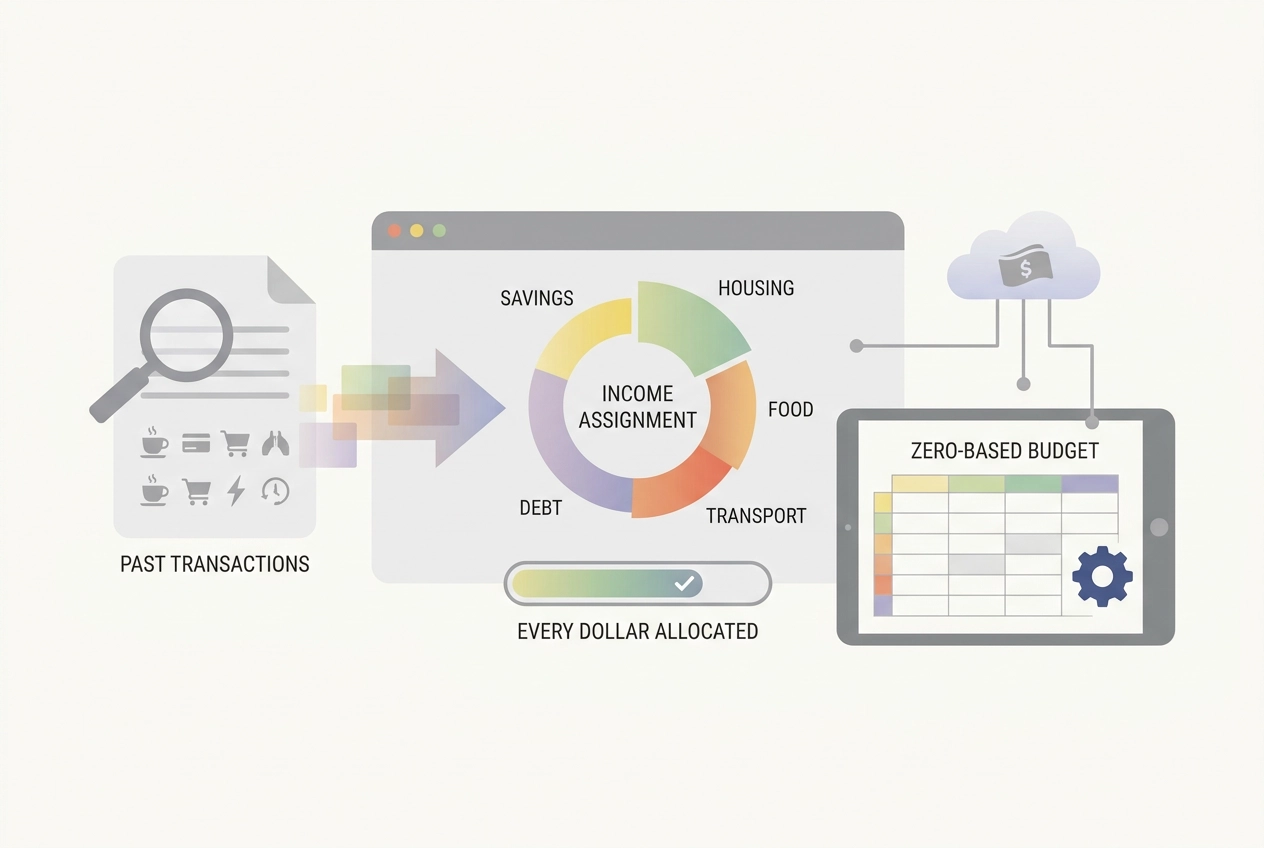
Learn how to apply zero-based budgeting to real bank statement lines, assign every dollar to an actual obligation, and reach zero without guesswork.
Your bank statement already knows where your money went. The problem is turning that list of transactions into a plan you can actually follow. That is where zero-based budgeting comes in, and it works best when you build it from real statement lines instead of imagined categories. Zero-based budgeting simply means giving every dollar a job. When you start with what already cleared your account, you are not guessing at bills or hoping your estimate is close. You are working with real obligations, so the amount left to assign is a known number, not a mystery.
Unlike some budgeting methods that begin with a blank template, this approach begins with proof. In this post, you will learn zero-based budgeting in plain terms, why starting from a statement beats a blank template, what to gather before you assign a dollar, and six steps to read statement lines, total real obligations, calculate what is left, assign every remaining dollar, verify you land at zero, and adjust mid-month. You will also see how statement-based ZBB compares to 50/30/20 and envelope budgeting, plus tips for keeping it running and privacy basics for digitized statements. Let's build your plan from what already cleared.
Zero-Based Budgeting in Plain Terms
Zero-based budgeting is a method where every dollar of income gets a named job before the month starts. The plan ends at zero because nothing is left unassigned, not because your account is empty. That distinction matters: money moved to savings still counts as assigned.
Zero-based budgeting also differs from a spending tracker. A tracker tells you what already happened. A zero-based plan decides what happens next, so it has to be built before or at the start of the period.
It earns a reputation for being rigid only when the numbers are guesses. Pull them from posted statement lines and the plan rests on facts you already have.
This guide takes that route. Instead of filling a blank template, you read your statement, total what it says must be paid, and assign only what genuinely remains. Curious how that stacks up against percentage methods? See The 50/30/20 Rule vs. Your Actual Statement.
Why Starting From a Statement Beats a Blank Template
A blank template makes you imagine categories and estimate amounts. A statement lists what you already paid, with a date and dollar figure on every line, so your starting point is documented rather than recalled.
Templates also invite omissions. Subscriptions, bank fees, annual renewals, and one-off charges rarely survive a guess, and those small leaks often break a first budget. If you would rather start from real transactions, free budget planner templates that work with statement data are built for it.
Statement lines then make the leftover an arithmetic result. Subtract posted obligations from cleared income and you get a number you can defend, not one you revise three times.
Comparing that statement against your assumptions exposes the gap between what you think you spend and what actually cleared. That gap is usually the most useful thing the exercise produces.
One limitation: a statement describes the past. Bills that have not posted yet still need room, which is why a mid-month adjustment comes later instead of pretending the first pass is final.
Prerequisites: What to Gather Before You Assign a Dollar
Here's what to gather first.
Statements. Pull one full statement period, ideally a complete calendar month, plus the period before it. Together they reveal every-other-cycle charges, like a quarterly subscription.
A way to group transactions. A spreadsheet, notebook, or tool works. StatementToBudget.com, per its own description, converts uploaded bank statements in PDF, CSV, XLS, or OFX formats into categorized budget insights using bank statement OCR and transaction extraction, free of charge. Start with these budget categories every American spends in.
Real income. Use paychecks that actually landed during that same period, not a projected salary. Cleared deposits keep it honest when hours vary.
Your zero target. Write down the number you want to land on once every dollar has a job, and keep it where you can see it.
Off-statement obligations. List cash rent to a family member, cash tips to a sitter, or an annual premium paid from another account. If it never hits the statement, add it manually or your plan runs quietly short.
Step 1: Read Statement Lines as Real Obligations
With your statement open, treat every line as a real obligation, including a three dollar debit. A small charge is still an assigned dollar, and skipping those is how a plan stops matching reality.
Sort each line into one of four buckets: must-pay (rent or mortgage, utilities, insurance, minimum debt payments), committed (phone plans, streaming, childcare, gym), flexible (groceries, fuel, dining, personal care), and one-off (car repair, late fees, annual renewal).
Flag duplicates and refunds. A returned purchase or reversed fee counted twice inflates a category and makes your obligations look bigger than they are.
Step 2: Total the Obligations Your Statement Already Proves
Now that every line has a bucket, add up what the statement proves. Total must-pay lines from posted transactions, not from memory of what rent or utilities cost.
Keep committed lines separate so you can see how much income is already spoken for before you choose anything else. Budgeting tips that actually work for beginners help you spot patterns in those lines.
Pro-rate annual costs: divide yearly insurance, registration, or membership fees by twelve and set that amount aside monthly. A bill that arrives once a year is still a monthly obligation.
Include account fees, interest charges, and overdraft costs in the first month's fixed total. Overdraft and insufficient funds fees average around $30 per transaction, so they are real obligations. You can reduce them later, but ignoring them makes the remaining pool look bigger than it is.
Step 3: Calculate the Money Left to Assign
Subtract the fixed and committed obligations you just totaled from income that cleared in the same period. The difference is your working pool, the real money you can assign. If your pay varies, build from cleared income in a recent slow month, not your best one. That way extra income becomes something you assign, and a slow month does not wreck the plan. If the pool is below zero, you have a shortfall, not a trimming problem. That changes which lines you touch first. Keep this number visible as you work through the next step, because it is the figure you will spend down to exactly zero. To see the whole statement-to-budget flow, read How to Create a Personal Budget From Your Bank Statement in Under 30 Minutes.
Step 4: Assign Every Remaining Dollar to a Named Line
You have your pool. Now give every dollar of it a job, in priority order: required living costs first, minimum debt payments second, savings and goals third, discretionary spending last. That sequence decides what gives way when the pool is tight.
Name each line and use a whole dollar amount. "Groceries: $480" is a decision. "Food: 12% of income" is not. Fund irregular expenses on purpose, including holiday gifts, car maintenance, back-to-school costs, and annual renewals. Put them in before fun money, or they get absorbed by whatever is left, which is usually nothing. Your statement may also reveal the 7 spending categories you've probably never budgeted for that belong here.
Stop when the pool hits zero. Unassigned dollars mean an unfinished plan, and unassigned money disappears without you choosing where it went. If a new line needs funding, reassign from another line so the plan still totals zero. Adding money from outside the pool turns a plan into a wish list.
According to the 2024 Survey of Household Economics and Decisionmaking, 63% of adults would cover a $400 unexpected expense with cash, savings, or a credit card paid off on the next statement; the remaining 37% would borrow or sell something. Car repairs alone can run well into the hundreds of dollars, according to Kelley Blue Book. Those figures show why a named irregular-expense line matters before something breaks.
Step 5: Verify You Land at Zero and Find the Leaks
Once every line has a number, add them up. The total has to match the pool from Step 3 exactly, not approximately.
ATM withdrawals need a decision. Most show a lump sum with no detail, so either assign them to a single named cash line or rebuild the breakdown from receipts. Skip this and your categories will never reconcile.
Then compare each assignment against last month's statement. If the same category ran higher than you planned, the assigned amount is wrong, not your willpower. Fix the number.
Finally, check the math once and stop. A plan you keep rewriting never gets followed; the number is there to be spent, not perfected. If matching your plan to your statement feels fuzzy, this plain-English guide to bank reconciliation explains it.
Step 6: Adjust Mid-Month Without Rebuilding Everything

Your plan totals zero, but mid-month reality rarely cooperates. Here is how to stay on track without starting over.
Keep a buffer line. Set aside a small amount for categories that wobble, like groceries or fuel. One buffer line covering a single overspend beats rewriting the whole plan in week two.
Move money, not the total. When reality changes, take dollars from one line and give them to another. The plan still ends at zero; only the labels move.
Let timing slide. If a bill posts earlier or later than expected, adjust it in the following cycle. That keeps this month's plan matched to this month's money.
Rerun against the next statement to keep the plan anchored to posted facts.
How Statement-Based ZBB Compares to 50/30/20 and Envelope Budgeting
Beyond those adjustments, here is how this method stacks up against other budgeting strategies.
By convention, the 50/30/20 rule splits income into needs, wants, and savings by percentage. It is fast to start, but with variable income those percentages produce dollar amounts that change every month. Statement-based zero-based budgeting assigns fixed dollars to named lines instead.
Envelope budgeting, as the method is commonly described, caps each category with a set amount, held in cash or digital envelopes. That is the holding stage; zero-based budgeting is the assignment stage that sets how much goes into each envelope.
Statement-based zero-based budgeting starts the assignment from posted transactions instead of estimates, making the leftover pool a known figure rather than a guess. The methods are not rivals: many people build the plan from a statement, then track assigned amounts with envelopes or a spreadsheet.
Pick based on friction, not ideology. Steady income and a quick ten-minute setup? Percentages work. Income that moves or bills that are lumpy? Assigning visible dollars is more durable.
Tips That Keep a Statement-Based Budget Running
Whichever mix of methods you choose, the plan only survives if the habits around it stay simple. Build from a month you already survived, not a hypothetical one. Real figures from a real cycle remove the biggest cause of abandonment. Round to whole dollars. Cents add noise and make the plan harder to read and follow. Give each known irregular expense its own sinking-fund line. A car maintenance line and a holiday line are easier to protect than one vague savings category. If income is unpredictable, treat anything above your base as income to assign when it arrives, which keeps the base plan honest. Review monthly, not daily. A plan you check constantly gets rewritten constantly, and a plan that changes every few days is not actually a plan. Now that the habits are set, the next thing to settle is what happens to your statement files.
Privacy Basics When You Digitize Statements
Once your plan is running, the statements feeding it are as sensitive as a scanned ID. A statement shows your account numbers, your address, and a detailed map of where you shop.
Before uploading a file, read what the tool says it does with it: how long files are kept and whether they are used for anything beyond the analysis. StatementToBudget.com describes its uploads as secure and free, but any service's terms deserve your own check.
If a tool only needs transaction lines to categorize, crop or redact account numbers and other identifiers first.
Keep the original statement in a protected spot on your own device. Avoid emailing statement files to yourself or parking them in a downloads folder.
Finally, treat categorization quality and data handling as separate questions. A tool can sort every transaction perfectly and still not match how you want your financial data stored. Handle both, and the real work is done: building next month's plan from what already cleared.
Conclusion: Build the Plan From What Already Cleared
Once your statement files are handled carefully, the method itself is straightforward. The process is the same each month: total what the statement proves, assign the remainder to named lines until the pool hits zero, and reallocate, never add, when something shifts.
Then rerun the exercise against each new statement. Doing it once gives you a snapshot of your zero-based budgeting plan. Doing it monthly gives you a budget tied to what you actually paid.