Smart Money Habits You Can Prove in Ten Minutes a Month

Three smart money habits you can prove from your statement in ten minutes a month, plus the bad money habits that fade without a trace.
Most money advice asks you to feel motivated. That feeling usually fades by Wednesday. A better approach? Look for smart money habits that leave a trace in your bank statement. If you can verify a habit in the data, you do not need a pep talk. You need a quick glance. This post is about the habits that show up every month: money moved before it was spent, a fee-free month, and staying under plan. Together, they turn your monthly review into a scoreboard.
The Fed's 2025 household survey found that 63% of adults said they would cover a hypothetical $400 expense with cash or its equivalent, and 55% had three months of emergency savings. Those figures show why measurable buffers matter, even though the three-habit framework here is practical, not a research finding. You'll learn why habits that leave a trace stick, what counts as a smart money habit, how to run each of the three checks, how to do the ten-minute review, how to spot bad habits your statement cannot prove, and answers to common questions. Then you can run the checks and let the scoreboard do the work.
Why Money Habits That Leave a Trace Are the Ones That Stick
A money habit you cannot check is a money habit you cannot keep. Nothing in your life ever confirms it happened, so nothing keeps it honest.
Compare the two feedback styles. A pep talk runs on mood and memory: motivating in January, gone by March. A scoreboard runs on a line item you can point to on a page, and it works in months you feel motivated and months you do not.
Intention alone has not held. In the Fed's 2025 household survey, 63% of adults said they would cover a hypothetical $400 expense with cash or its equivalent, unchanged from prior years. That same report found the $400 measure, the three-month rainy day fund measure, and the share of non-retirees who feel their retirement plan is on track were all down from 2021 levels.
That gap between wanting progress and proving it is where a statement earns its keep. A monthly review built on your bank statement turns raw transactions into feedback you can act on.
One honest note before we start: the three habits ahead are a practical framework for organizing a monthly review, not a research finding. No study validates this specific trio. But each one leaves a trace, and a trace is something you can score.
What Counts as a Smart Money Habit? The Trace Principle
Here is the rule that separates a real habit from a wish: the trace principle. A habit you can prove leaves a mark in your statement, and that mark takes one of three forms. A dated transaction, like a transfer on the 3rd. A balance change, like savings climbing $200. Or a deliberate absence of charges where fees used to appear.
Run three questions before adopting any habit:
Does it appear as a line item?
Can you confirm it in under a minute?
Does it repeat in the same form each month?
Compare "I want to save more" with "a transfer cleared before my first discretionary purchase this month." The first lives in your head; the second lives on a page.
Four terms to know:
Statement period: the start and end dates of one billing cycle.
Posted versus pending: posted transactions have cleared, while pending ones can still change.
Plan: your own target spend number, not a national average.
Fee: any charge from your bank, including maintenance, overdraft, and out-of-network ATM fees.
One honest note: linking the three-month savings benchmark to a monthly transfer check is a reasonable logical connection, not a proven causal relationship. For the ritual that turns these checks into a routine, see How to Build Good Money Habits Using a Monthly Statement Review.
Habit 1: Money Moved Before It Was Spent
Now point the trace principle at your savings account. Habit 1 means the money reaches savings before any discretionary spending starts, rather than being whatever happens to be left at month end. Savings first, spending second.
The check takes under two minutes. Search the statement for recurring transfer lines, then answer three things: did each transfer clear before or after payday, did it land before your largest discretionary debits, and does the balance pattern hold steady from period to period?
For context, the Fed reports that 55% of all adults had three months of emergency savings in 2025, down from a 59% peak in 2021 (Federal Reserve emergency savings data). Treat three months as a long-run target, not a monthly pass or fail line. One statement period cannot measure where you stand against it.
In practice, the failure modes look like this: a transfer scheduled after bill due dates, a transfer that gets reversed, or savings pulled back out during the same period. Each one turns saving into a round trip.
Automation is why this habit stays provable. A scheduled transfer appears as a recurring line item, so the check works even in months you pay it no attention. If the plan behind the transfer still needs building, 10 Budgeting Tips That Only Work Once You Can See Your Real Spending starts from your actual numbers, not a wish.
Habit 2 asks a different question: did the period stay fee-free?
Habit 2: A Fee-Free Month
A savings transfer you can point to is one check. A fee-free month is the other half of that same page.
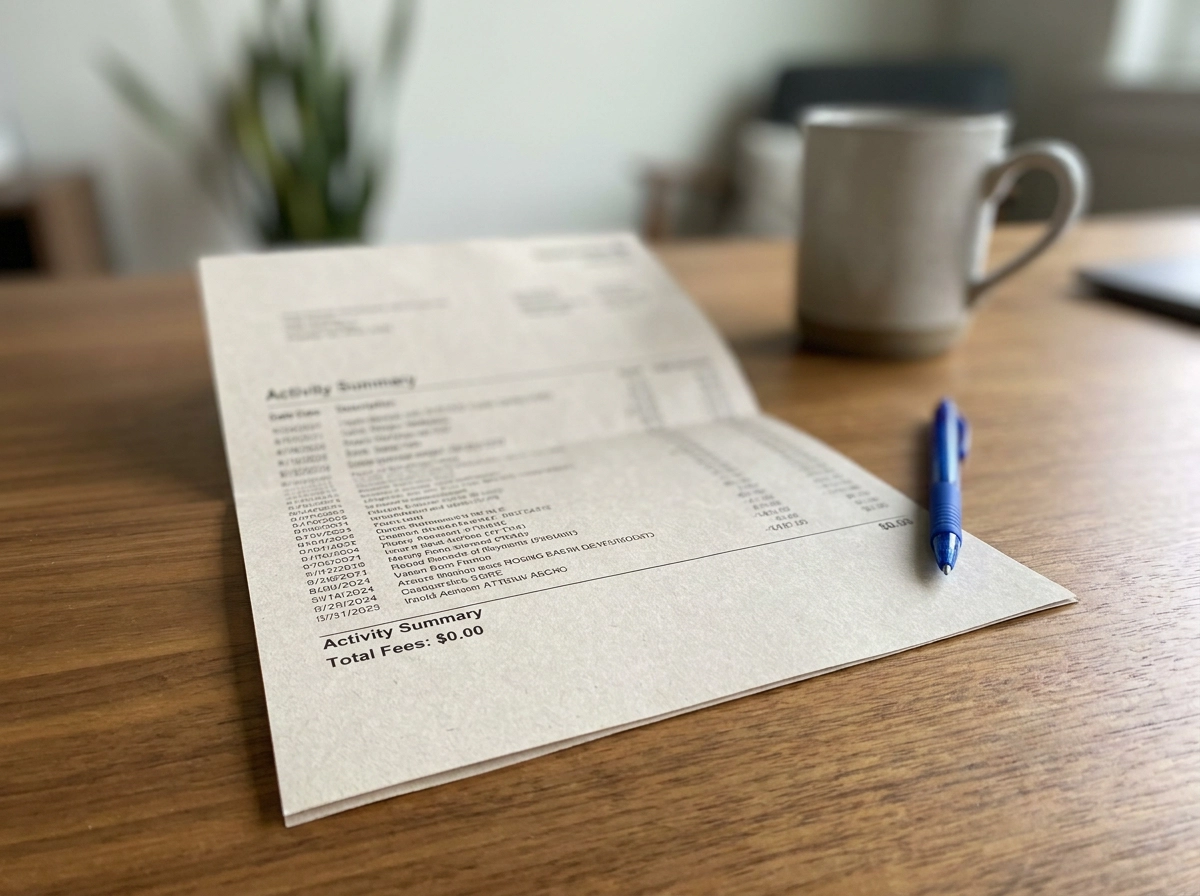
A fee-free month means one statement period with zero bank-charged fees: maintenance fees, overdraft and insufficient funds charges, out-of-network ATM fees, and foreign transaction fees.
The check takes about a minute. Scan the statement for lines containing "fee," count them, then compare the count to last month rather than to a national average. Fees often sit inside the hidden cost categories your bank statement reveals once transactions are grouped. Your own month-over-month count is the honest baseline, since public data does not quantify how often maintenance, ATM, or foreign transaction fees hit consumers, or how large they are. Overdraft and NSF fees are the exception, and the CFPB has tracked overdraft and NSF revenue falling more than 50% versus pre-pandemic levels.
Most avoidable fees trace to four causes: dropping below a minimum balance threshold, using an out-of-network ATM, letting a card sit inactive, or letting a payment land after the cut-off time.
Treat each fee as a flagged item, not a moral failure. The count exists to produce one concrete fix for next period. That single fix is the whole point, and the next check works the same way, comparing spending to a number you set in advance.
Habit 3: Staying Under Plan
A fee-free month is money you did not lose. Staying under plan is money you chose not to spend. Both are numbers you can point to on the page.
This habit means total variable spending for the statement period landed at or below a number you set in advance, after savings transfers and fixed bills were set aside. Groceries, gas, dining, and shopping are variable. Rent and insurance are not.
Build the plan from evidence, not wishful thinking. Total the variable categories on your last two or three statements, then set the target slightly below that average so it stays reachable. If you are still finding your baseline, this guide to budgeting tips for young adults walks through starting from a first paycheck.
Verify by adding up the debits in each category, comparing that total to your plan, and noting the two or three categories that moved most. Those movers are where the next fix lives.
StatementToBudget shortens the arithmetic to a glance: upload a statement in PDF, CSV, XLS, or OFX format and it converts the file into categorized spending insights and totals at no cost.
Three things break the plan: a target invented instead of derived from real statements, irregular annual expenses ignored, and mixed categories that hide where the money actually went.
The Ten-Minute Monthly Review That Turns Three Checks Into a Scoreboard
Once your plan number exists, the monthly review is four steps: open the statement, confirm the savings transfer cleared first, count the fee lines, then compare variable spending to your plan. Write down all three results.
Run it on the same date every month, right after the statement posts. Same date, same order. That makes it a routine instead of a fresh decision.
Score it like a scoreboard: three checks, three possible passes. A running tally of 2 of 3 tells you more across months than any single month ever will.
When one check fails, use the one-fix rule. Change one thing next cycle. Do not rebuild the whole system. A check that stays in place beats a perfect plan you abandon.
Warning: do not change all three habits at once. One failing check is a signal. Three failing checks usually mean your targets are unrealistic, not that you need more willpower. If you want more help setting targets from real transactions, see Budgeting Tips That Actually Work for Beginners (Backed by What Your Statement Shows).
Bad Money Habits: The Ones Your Statement Cannot Prove
The review you just ran has a useful side effect: it makes the opposite kind of habit easy to spot.
Bad money habits are usually intentions with no line item behind them. "I'll start saving next month." "I've gotten better with money." Nothing in the statement confirms or denies either one. And a handful of them hide in plain sight: a recurring fee you stopped noticing, a transfer you reverse within the same statement period, or slow spend creep in one category that never trips your attention. Several of these rank among the common mistakes people make when reviewing their bank statements.
None of that is a character flaw. It is a missing feedback loop. When nothing monthly confirms or corrects the pattern, the pattern just continues. That is why the fix is structural: a bad money habit is usually an unmeasured one, so you attach a check to it instead of promising more willpower.
One honest note on context. The Fed's 2025 figures put three-month emergency savings at 72% for adults with a bachelor's degree or more versus 21% for those with less than a high school diploma, and 68% for Asian adults versus 38% for Black adults. A monthly habit does not close gaps like those. Treat the numbers as context, not as anyone's personal failing.
Attach the check, and the habit stops hiding.
Frequently Asked Questions About Money Habits
So how do you tell which of your own habits are the provable ones? These quick answers should help.
What are the best smart money habits? The ones your statement can verify every month. Start with a savings transfer that clears before discretionary spending, a fee-free statement period, and variable spending under a plan you set in advance. No statement line, no habit.
How do I track money habits without a spreadsheet? Run the three checks right on your statement. Or upload the file to a tool that categorizes transactions automatically, so the totals arrive already grouped.
What is a bad money habit, exactly? One that leaves no trace you can check. That is why it survives your motivated months and your unmotivated ones alike.
How long does a money habit take to stick? Treat the first three monthly reviews as calibration. Early cycles are for finding a target you can actually hit, not for chasing a perfect month. For a deeper walkthrough, see How to Build Better Money Habits Using Your Bank Statement as a Feedback Loop.
Conclusion: Run the Three Checks and Let the Scoreboard Do the Work
You have the answers. Here's your closing checklist, and you can run it against one statement period before you change a single habit.
Savings moved before spending: a transfer to savings cleared before your first discretionary purchase.
Zero fees this period: no maintenance, overdraft, ATM, or foreign transaction charges appear.
Variable spending under plan: your categories totaled at or below the number you set in advance.
Write down the results. Two out of three is a score, not a verdict. Pick one fix for next month and leave the rest alone.
That's the whole point. A habit survives when a page confirms it every month. Habits that never show up in the data fade on their own, and you can let them go without ceremony.
Start with a single statement period. Pull the file, spend the ten minutes, and record your score before you adjust anything. Your first month is a baseline, not a report card.
One honest note: this three-check framework is a practical organizing tool, not a research-backed prescription. The Fed figures referenced above describe the broader savings picture, not a standard you have to hit in month one.