Two Statements, One Budget, No Joint Account Required
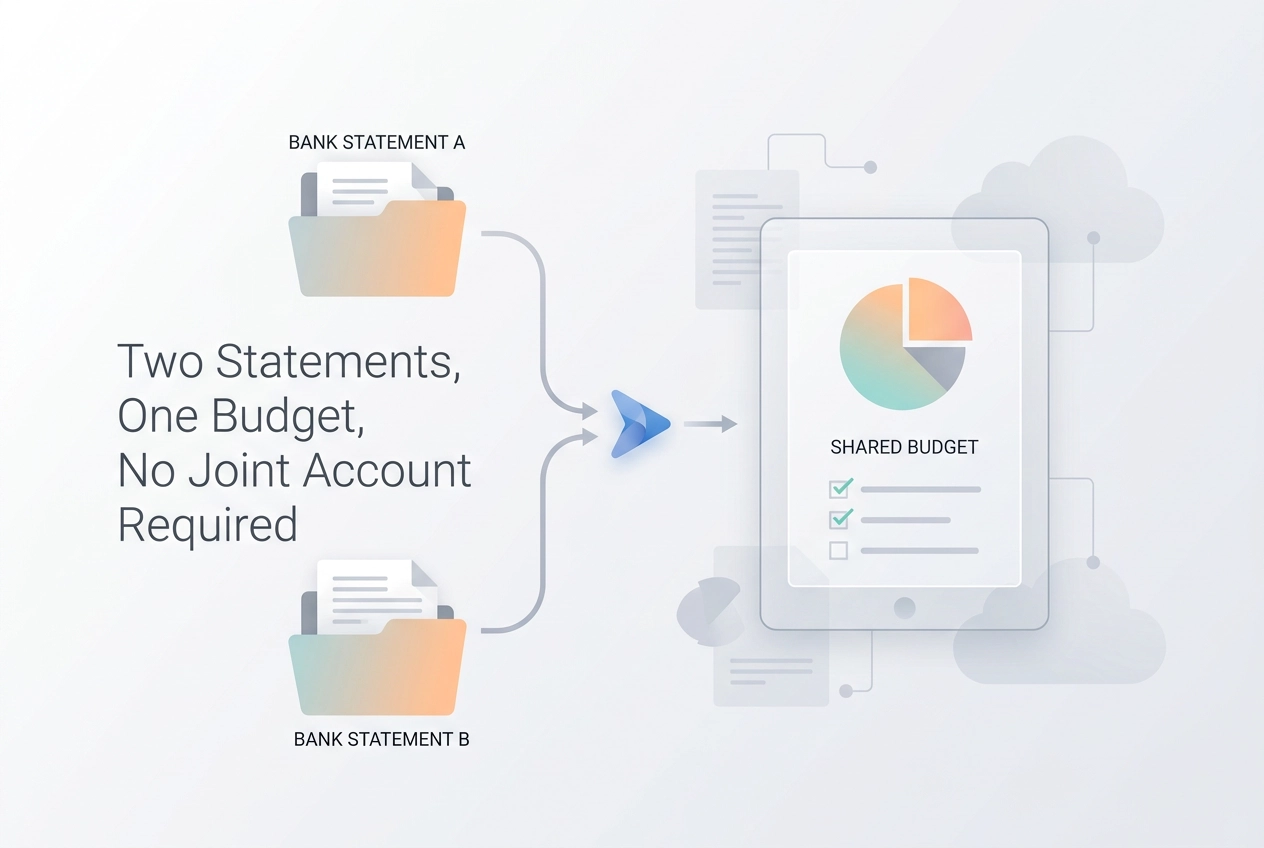
Skip the joint bank account. Learn how to match two personal statements line by line, recurring items first, and build one household budget you both trust.
What if you could build a household budget without opening a joint account? Many couples want shared money clarity, yet joint bank accounts for couples are not the only path. If you have ever tried to budget from one person’s spending, you already know why that approach can miss half the picture. Instead, you can match two personal statements line by line: recurring items first, discretionary second, then combine categories into one shared budget. This post walks you through that method from start to finish.
You will see why separate accounts are common and why joint accounts are not mandatory. Then we will cover what to have ready before you match anything, how to line up the same period from both statements, match recurring items, sort discretionary spending, and combine categories. We will also tackle transfers, split bills, mismatched cycles, sharing statements without losing trust, when a personal budget template is not enough, and how to keep the system alive each month. If you use a tool like StatementToBudget, which offers OCR, categorisation, and free access, the matching process can be faster, but the core habit matters more. Ready to build a budget that respects both accounts?
Why Joint Bank Accounts for Couples Are Not the Only Answer
Keeping money separate is normal, not a warning sign. Almost a quarter of married couples had no joint account in 2023, up from 15% in 1996, per the Census Bureau. Buffers are thin too: in the Federal Reserve's 2026 report on 2025 finances, 63% of U.S. adults would cover a hypothetical $400 expense with cash, savings, or a credit card paid off at the next statement, below 2021 levels. A shared plan matters more than a shared account.
The problem this method solves: a budget built from one person's account only sees that person's rent, groceries, and subscriptions. The other partner's spending stays invisible, so the plan misses half the household.
Opening a joint bank account for couples transfers ownership of every dollar deposited into it. Building from two statements changes only what both partners can see, and leaves each personal account intact.
A 2019 UCLA Anderson Review piece asked whether joint accounts relate to happier couples; Bankrate's couples survey reports most keep some money separate. Both are context, not a verdict.
What to Have Ready Before You Match Anything
Before you open a spreadsheet, four things need settling.
Two statements, same period. One monthly statement each is the minimum, and the same month from both banks is easier to reconcile than two different cycles. Download three months per person if you can: recurring items repeat and one-offs stand out against a longer baseline, so a charge that appeared twice does not get mistaken for a fixed cost.

Check your formats. One bank may give you a PDF while the other exports CSV. StatementToBudget accepts PDF, CSV, XLS, and OFX uploads, so mismatched files go through in one pass without manual typing. Our comparison of bank statement converters for personal budgeters covers the rest.
Agree what counts as shared. Housing, utilities, insurance, groceries, childcare and commuting costs versus what stays individual. Settle that before you see the figures, not after.
Set your disclosure ground rules. Full line items, or category totals with detail kept private? Decide before the first statement is opened.
Now line up the periods.
Step 1: Line Up the Same Period From Both Statements
Start with the cycle dates, not the balances. One bank may run the 5th to the 4th while the other runs the 1st to the 31st, and overlapping windows double count the days in between. New to reading statements analytically? How to Read a Bank Statement for Budget Insights (Not Just Balance Checks) is worth ten minutes.
Pick one working period per pass. A calendar month is simplest. Where a cycle does not fit, use the closest 30-day window and write down the offset.
Avoid mixing a four-week cycle with a calendar month. Credit cards closing mid-month are the usual culprit: align the card to the period it mostly covers, or split it at the statement date.
If either partner runs more than one account, list them before matching. A current account, a card and a savings transfer is one person's spending across three documents.
Finally, categorise both statements the same way. StatementToBudget converts uploaded PDF, CSV, XLS or OFX files into categorized budget insights, giving both partners identical category names to compare.
Step 2: Match Recurring Items on Both Statements First
With both statements on the same period, start with what repeats. Recurring costs set your household floor, and they arrive whether income is steady or not. Until both partners' recurring lines sit side by side, you cannot tell whether the shared number is affordable.
Three signals mark a recurring item: the same merchant, a similar amount, and a regular cadence (monthly, quarterly, annual). The usual list runs rent or mortgage, utilities, phone plans, insurance premiums, loan and auto payments, childcare, and subscriptions.
Build two lists first: statement A on the left, statement B on the right, each with its amount and cadence.
Normalise anything that does not bill monthly: divide an annual insurance premium by 12, a quarterly membership by 3, so every line sits on the same monthly footing.
Label each one shared, individual, or split. Rent paid from one account for a shared home counts as shared, even if only one statement shows it. Leave nothing unlabelled; that is where two-statement budgets quietly break.
Stop there. Do not touch discretionary spending yet. Pulling categories together before the recurring lists are complete gives you a total that looks reasonable and is missing a fixed cost. If either partner keeps several accounts, Combining Multiple Statements for a Household Budget covers the merge.
Step 3: Sort Discretionary Spending Second
With your recurring lists sitting side by side, only now should you turn to discretionary spending. These are the variable costs: groceries, fuel, dining, clothing, gifts, hobbies, personal care. Because they move monthly, match them as averages across your downloaded period, not single figures.
Then split them. Groceries and household supplies belong in the shared column even when only one partner bought them. A gym membership or hobby subscription stays in that partner's individual column.
Watch for recurring-in-disguise items. Weekly meal delivery and auto-renewing streaming tiers read as discretionary but behave like fixed costs. If it repeats every cycle at a similar amount, move it up to the recurring list.
Keep personal spending visible. The goal is a shared household picture, not one partner's spending itemised for approval. Category totals are enough.
Finally, use identical category names on both sides. If one statement says "groceries" and the other says "food," the merge misses it. An automated categorising pass avoids that, and it is where 10 budgeting tips that only work once you can see your real spending finally get traction.
Step 4: Combine Categories Into One Household Budget
Add the shared recurring lines from both statements. That sum is your household fixed floor, the first real output. Agree on it before you add a single discretionary pound.
Next, add average shared discretionary spending to the floor. Shared fixed plus shared discretionary is the monthly cost of running the household, the figure a joint account would have been built to cover.
Keep individual lines separate but inside the same plan. A three-column layout works: shared, partner A, partner B, with a household total row underneath. The budget is one document; the spending does not have to be.
Decide how the shared total gets funded. You could each transfer a fixed amount into a shared pot, pay assigned bills directly from personal accounts, or contribute by income proportion. None of these need a joint account.
When you recheck, compare transaction amounts, not balances, since statement balance vs current balance measure different things.
Write the agreed numbers somewhere both partners can see, then test them against the next statements. The static number is the target; the statements are the evidence.
The Awkward Parts: Transfers, Split Bills, and Mismatched Cycles
Transfers between your own accounts are not spending. A move from your current account to savings, or a payment to your own credit card, shows as an outgoing amount but inflates the household total twice.
On shared credit cards, count the purchase, not the payment. Purchases were already logged on the card statement, so a payment from a personal account is a transfer, not a new expense.
Reimbursements need two lines. If one partner covers rent and the other pays them back, record one rent line and one reimbursement line, so rent is never counted twice.
Choose a split ratio and state it. Fifty-fifty is simple; income-proportional is fairer when earnings differ. Apply it to the shared total consistently, then each partner funds their share from their own account.
Annualise bills that do not arrive monthly. Seasonal utilities, semiannual insurance and quarterly memberships convert to monthly equivalents, so the household number stops swinging every time a bill lands.
With those lines cleaned up, the next question is how much of each statement you actually share.
Sharing Statements Without Losing Trust
Once those awkward items are sorted, agree on sharing rules before anyone opens a PDF. Three options exist: category totals only, shared line items, or full detail. Whichever both partners genuinely accept works.
Redact what the plan does not need: account numbers, unrelated savings balances, and any spending you have both agreed to keep private.
Or skip raw statements entirely. Each partner uploads their own PDF, CSV, XLS, or OFX file to StatementToBudget, which uses bank statement OCR and transaction extraction to create categorized budget insights, then shares only the output the plan needs. To see what data access really involves, read how bank feeds turn transactions into a budget.
Consent is ongoing, not permanent. A couple who shared everything in a tight month can drop back to category totals the next, without it reading as concealment.
One honest note: the matching method is a recommended approach, not a research finding. The evidence covers how many couples keep accounts separate and how thin buffers are; the two-statement process is a practical way to work with that.
When a Personal Budget Template or Sheet Is Not Enough
Now that sharing is settled, a fair question follows: if you already have a personal budget sheet, why not just fill that in?
Because a template gives you blank categories and a formula. It does not know what your household buys, so every figure has to be typed in from somewhere else. And a sheet built for one person hides the second person's spending by design. It looks complete, the total looks fine, and half the recurring bills were never entered.
Flip the order. Upload the statements and the categories arrive with actual amounts attached, so your first draft reflects what was really spent. From there, free budget planner templates that work with statement data earn their place as the front page for your agreed shared total and monthly check-in, with the statements as the source of truth behind it.
If the real appeal of a template is not typing every line, statement conversion solves exactly that. StatementToBudget turns PDF, CSV, XLS, and OFX statements into categorized insights instantly, securely, and at no cost.
What matters next is keeping those numbers current.
Keeping a Two-Statement Budget Alive Month After Month
Once the first match is done, keeping the plan alive is mostly routine. Refresh when both statements close, not on a random date; twenty minutes to update the shared fixed floor and the shared discretionary average is enough.
Re-match the recurring list whenever a price changes. Subscription increases, insurance renewals and utility rate changes are the three most common reasons a household budget drifts from reality.
Add new shared costs by agreement, and let new individual costs stay individual. A new pet, car payment or childcare arrangement belongs in the shared column; a new hobby stays where it started.
Treat one-time items separately. Car repairs, travel and medical bills do not belong in the recurring floor, but they do belong in a sinking fund line so the next one does not land as a crisis.
Finally, keep the accounts separate unless both partners actively want to merge them. The shared object is the budget and the agreed numbers, and that arrangement can hold for years without either partner surrendering an account.
Your Next Three Moves
Ready to act? Do this.
Download one statement from each partner covering the same month, whichever format your banks provide, and place them side by side before deciding anything about accounts.
Match recurring items first on both sides. Label each shared, individual, or split, then add discretionary spending as averages. The household total falls out of those two steps.
Write down the agreed shared number, decide how two separate accounts will fund it, and book a twenty-minute review for the next statement cycle.
Almost a quarter of married couples, per the Census Bureau, run separate accounts. The plan, not the account, keeps a household budget accurate.
Conclusion
A two-statement budget puts the plan before the account. You and your partner can keep separate accounts while still agreeing on one shared number. Start by lining up the same month, then match recurring items first and sort discretionary spending second. Label each item shared, individual, or split, and combine the results into one household budget. Keep transfers, split bills, and mismatched cycles visible so they do not distort the totals. Review the shared number each cycle, update it when prices change, and treat one-time costs through a sinking fund. Your next move is simple: download one statement from each partner for the same month, place them side by side, and match the recurring items before deciding anything about accounts. Clarity grows from that first comparison, and every review makes the next month easier.