What AI Budgets Cannot Know About Your Money, and Why
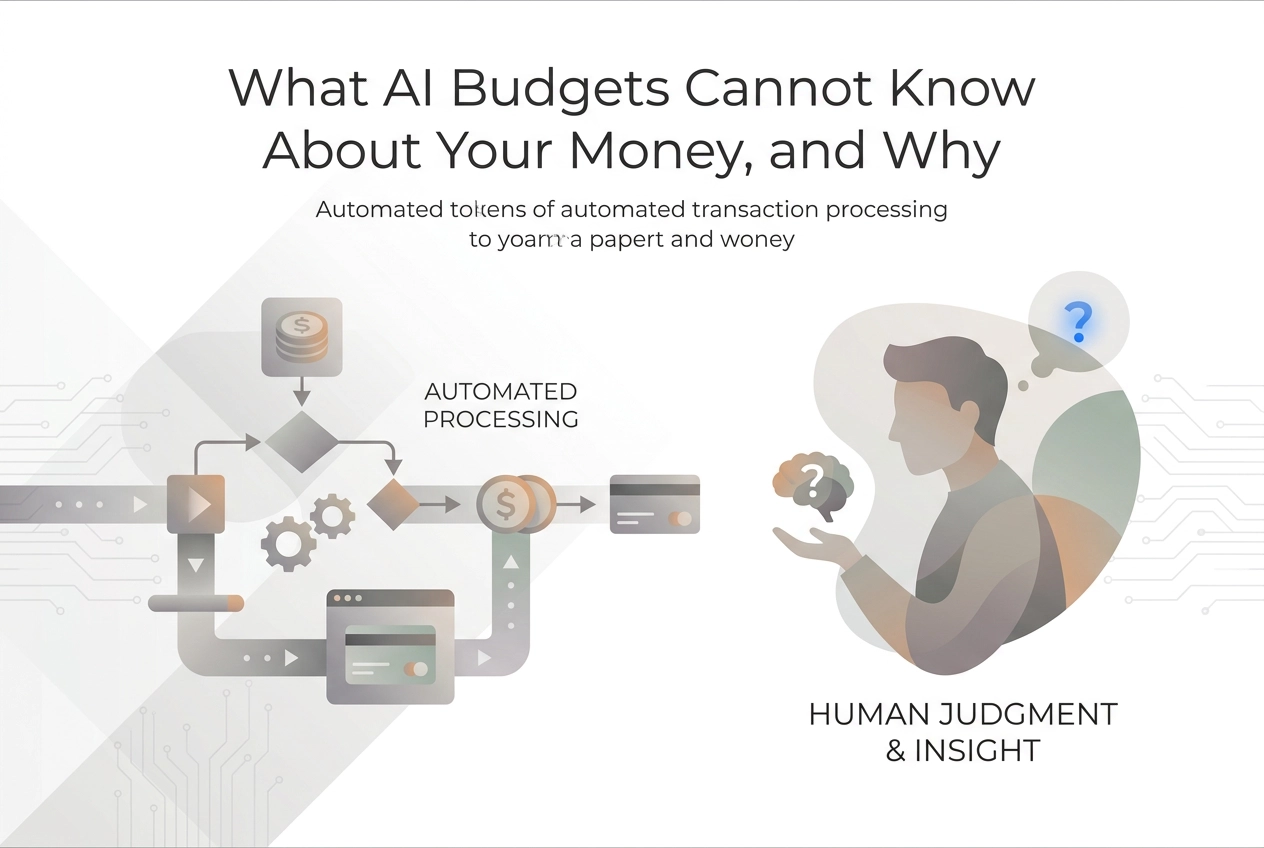
AI can classify, total and rank your transactions, but it cannot know what they mean to you. Start here to see which money decisions stay yours.
An AI can classify, total, rank, and flag every transaction on your bank statement. It cannot know that two dining charges were birthday gifts, one was a client lunch you will be repaid for, or that your monthly savings transfer is non negotiable. That gap between calculation and context is where budgeting becomes personal, and where trust in AI either holds or breaks.
This analysis draws a practical line between what AI can infer from a statement and what only you can decide about your life. You will learn what AI legitimately does with transaction data, where the signal runs out, why a transfer is not self explaining, and why categories are not facts. We will examine the judgment layer: non negotiable spending, what a goal means to you, and why an honest handoff beats a confident guess. We will also review the regulatory context with appropriate caveats and show how to use an AI budget without surrendering your judgment. The line is not a limitation to hide. It is the feature that makes an AI budget trustworthy.
The Assumption That AI Already Understands Your Money

Much of today's personal finance writing describes AI budgeting tools as though they "know" your spending habits, your priorities, even your weaknesses. That framing quietly merges two different capabilities. Processing reads a statement, extracts lines and sorts them. Interpretation decides what a line meant in your life. A tool can excel at the first and have no access to the second.
Every AI budget draws an invisible line between what it computes and what you must decide. A trustworthy tool makes that line visible.
What follows splits into two halves: the operations AI performs well because they are checkable, and the decisions it cannot make because the data they depend on never existed in the statement.
The argument here works from what a bank statement actually contains: date, amount, direction of funds and merchant descriptor, not vendor performance claims. For a fuller account of how extraction and categorisation operate on the processing side, read What an AI Budget Planner Actually Does With Your Statement Data.
What AI Legitimately Does With a Bank Statement
Processing, then, is where AI earns its keep. Five operations describe almost everything a tool can reliably do with a statement.
Classification matches descriptors and recurring patterns to a category, often with a confidence value. It is pattern matching against prior examples, not comprehension of your life.
Totaling and aggregation sum spending by category, month or merchant. This is arithmetic, reproducible by hand, which is why it can be trusted.
Ranking orders your largest expenses, fastest-growing categories or most frequent merchants, so the biggest levers surface instead of hiding on page nine.
Flagging spots duplicates, repeat subscriptions, unusual amounts and fee-like entries by comparing each transaction against a threshold or history, not against intent.
Underneath all four sits extraction: StatementToBudget.com accepts PDF, CSV, XLS and OFX statements and converts them into categorised budget insights via OCR and transaction extraction, free and without manual entry. If you are unsure whether you need an analyser or a simple converter, this comparison of a bank statement analyser versus a PDF converter explains the difference.
Every operation shares one property: its output can be checked against a statement line. That verifiability is precisely what makes these tasks safe to automate.
Where the Signal Runs Out: What a Statement Cannot Record
That checkability has limits.
Every statement line carries only a posting date, an amount, a debit or credit direction, a merchant descriptor and, occasionally, a short memo. Intent, relationship and obligation are not fields.
Take a £400 outbound movement. It could be a loan repayment to a family member, a birthday gift, a deposit on a used instrument, a shared household contribution, or a refund correction. Amount and descriptor can be identical in all five cases. The same applies to inflows: a monthly credit might be salary, a recurring benefit, a housemate's rent share or a support payment.
This is structural, not statistical. The problem is a missing data field, not a weak model; better models cannot invent a field that was never captured. Decoding confusing transaction descriptions helps with strings, not with meaning.
That boundary is not a temporary limitation awaiting an engineering fix. It is the shape of the data, which makes the human decision layer permanent rather than a stopgap.
A Transfer Is Not Self Explaining
Descriptor strings are compressed and generic by design, which is why unrelated merchants can look alike and one merchant can appear under several strings across statements. Inconsistent and confusing descriptor names are a recognised industry problem rather than a rare one.
A tool can learn that two transactions share a counterparty pattern. It cannot learn whether that counterparty is your landlord, your sibling or your own second account; reading your statement analytically helps you see where that meaning is missing.
The downstream cost is contamination. One misread transfer flows straight into category totals, savings rate and every ratio built on top of them.
The fix is small: name transfers as they happen, keep a short note on recurring movements, and correct labels within the first review cycle rather than at year end. Even then, categories remain yours to define.
Categories Are Not Facts
The descriptor problem ends where your judgment begins. A category is a bucket you define, not a property a transaction carries. Give two households the same statement and they will draw the lines in different places, both correctly.
A single £45 gym charge makes the point. One person files it under health. Another files it under recreation. A third treats it as a fixed, non-negotiable commitment because it manages a condition. The amount and descriptor are identical; the meaning is not.
Prebuilt category sets are a starting taxonomy. They buy comparability across households, not authority over yours. How AI is changing transaction categorisation in 2026 shows how quickly those defaults get proposed, and how little they settle.
So treat each AI categorisation as a proposal awaiting approval. The approval step is where personal budgeting starts, not where it ends.
The Judgment Layer: Decisions That Stay With You
If a category is a proposal, something must approve it. That something is you, and approval opens a wider layer of judgment no processing pipeline can supply: value-laden, context-dependent decisions resting on obligations, relationships and preferences no statement records.
The recurring judgments are recognisable. What a transfer really was. Whether a category reflects how you think about your money. Which costs are untouchable. What a goal requires. Which trade-offs you would accept.
The tool's role in each case is identical: surface the pattern, ask the question, hold the answer once you give it. Surfacing and asking are automatable. Answering is not.
Skipping this layer has a specific failure mode. A budget you never corrected reads as authoritative data, and people act on authoritative data even when it is wrong about their life.
That is why speed matters. The value of an AI budget lies partly in how quickly it produces the prompts for these decisions, not in making them on your behalf.
What Is Non Negotiable
A non-negotiable is a category, or occasionally a single line item, that should not be reduced by default simply because it looks large against a savings target. The asymmetry is the point: a £60 monthly payment can be pure discretionary spending in one household and mandated medication or essential transport in another. The statement shows the amount, never the obligation.
So mark those categories. Exclude them from cut suggestions, shield them from automatic relabelling, and report them separately from flexible spending. This is a human act with a real consequence: it changes which numbers the tool prompts you to reconsider and which it leaves alone. That distinction then shapes what a goal asks of you.
What a Goal Means to You
Non-negotiables settle what you will not cut. A goal settles what you will.
"Saving more" stays incomputable until it carries a number, a deadline and a reason. Only the first travels into the tool. It can compute the gap between current spending and a target amount, and model what happens if a category changes. It cannot choose which reduction you will live with.
Guidance of the kind StatementToBudget.com offers is a prompt for your decision, not a verdict on your household; the site's terms confirm that it gives no financial advice. Reading it that way keeps the boundary intact.
Translate each goal into one trade-off you have personally approved. Then the plan reflects a choice you can name, not an algorithm's inference. The alternative, a confident guess presented as fact, is a less useful proposition.
Why an Honest Handoff Beats a Confident Guess
Once you have named the trade-off you will accept, the next risk is a tool that decides it silently.
A silent guess delivers two failures: a wrong number, and false certainty about it, since the error arrives with no visible seam.
Over months, a confidently wrong category can prompt you to cancel something you need or trim a fixed commitment that cannot be trimmed, and the advice wears a dashboard's credibility. The 2026 shift toward automated spending awareness makes this timely.
Regulatory attention to automated financial systems has increased, with the CFPB publishing research on chatbots in consumer finance as evidence of sustained scrutiny. Those expectations describe a consumer-facing virtue even where they are not legally owed to you. The Consumer Financial Protection Bureau has published a report titled "Chatbots in Consumer Finance," evidence of sustained attention to automated systems discussing money. Treat the title as interest, not a finding.
An AI budget that shows its confidence, cites the source transaction and accepts your override is more useful than one that appears omniscient: you can audit the first, not the second.
Regulatory Context, in Brief and With Caveats
Regulatory context sits alongside this argument without proving it. Secondary compliance summaries in 2026 describe a CFPB Personal Financial Data Rights rule calling for consumer-directed data access, portability and secure API-based sharing, with the first compliance date for the largest covered data providers set for April 1, 2026, though the rule has been enjoined and is under reconsideration. Attribute both to commentary, not quoted rule text.
Surrounding activity is easier to date: a House Financial Services Committee vote on H.R. 10184 reported 28 to 21 on 16 September 2026, a federal court ruling dated 25 September 2026 in New York v. Vought, and committee advancement of the Earned Wage Access Consumer Protection Act, H.R. 9330, on 6 July 2026.
Limits matter. These items concern supervision and institutional structure. Any link between consumer-directed data access and consumer budgeting tools is this article's inference, not a sourced claim.
The takeaway is thematic: regulation addresses your control over your data; this piece addresses your control over meaning. They sit comfortably side by side. For what a free tool should include, see Free vs. Paid AI Budget Tools.
How to Use an AI Budget Without Handing Over Your Judgment
That direction of travel concerns your control over data. The practice below concerns your control over meaning.
Handle the mechanical part with software. Upload a PDF, CSV, XLS or OFX statement to StatementToBudget.com and let OCR and transaction extraction build a categorised record instead of retyping lines during the only hour you had for planning.
Treat month one as a draft. Read the generated categories, rename what does not match how you think, and accept that the first pass exists to force those decisions, not settle them.
Carry your non-negotiable list into the tool so those categories are shielded from cut suggestions.
Annotate ambiguous movements once. Rename recurrent transfers and add a brief note where the descriptor cannot explain the entry, so meaning lives in the budget rather than your memory.
Use ranking and flagging as question generators. A jumped category or duplicate charge is a prompt to investigate, not a mandate to act.
Keep one rule: numbers come from the tool, meaning comes from you. Any tool that erases that rule trades trust for a smoother demo.
The Line Is the Feature
Three habits keep that rule intact.
The checkable operations belong to software; the rest stays yours.
An AI budget is more useful, not less, when it is candid about that handoff. A tool that tells you where its knowledge ends is one you can build on.
Conclusion
An AI budget is strongest when it knows its limits. The four checkable operations belong to the tool; intent, obligation and acceptable trade-offs remain yours. Your statement records amounts, not intent. That is why non-negotiable lines belong in a shielded list, ambiguous movements deserve one clear annotation, and category suggestions should stay drafts until you approve them. Numbers come from the tool; meaning comes from you. That division is not a weakness. It is the feature that makes the budget trustworthy.