Why Three Months of Statements Beat One Month Every Time
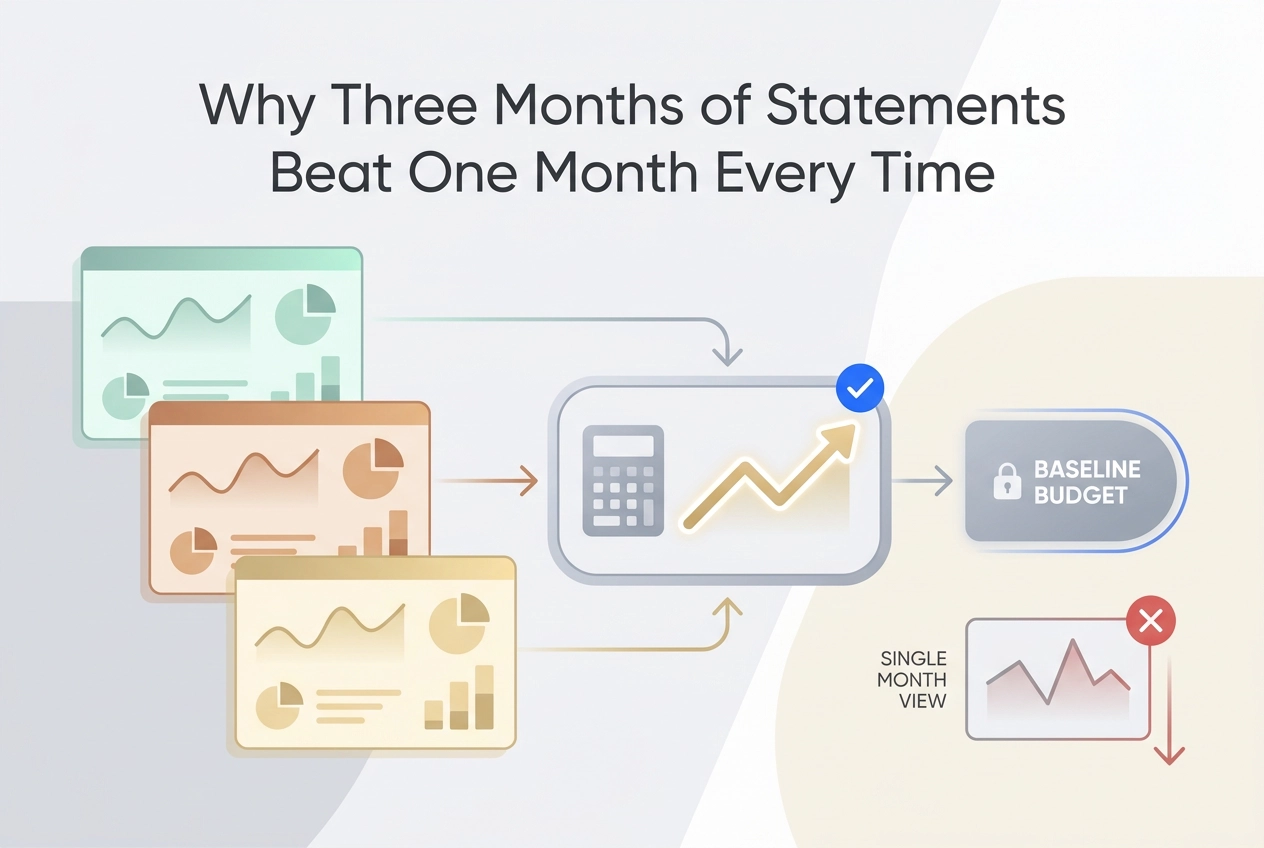
One month of statements shows that month's quirks, not your real budget. A three-month read turns seasonal spikes into a baseline you can defend.
One month of bank statements can make your spending look calm, chaotic, or somewhere in between. But a single statement is a snapshot, not a baseline. It might land in December and catch gifts, travel, and annual insurance. It might land in a quiet month and hide the bills that only show up once a year. If you build a budget breakdown from that one snapshot, you inherit its anomalies.
That is why reading three months of statements usually beats one. Three months absorb Christmas, holidays, and annual bills. Spikes become seasonality you can plan for, and you get a baseline number you can defend when the next irregular month arrives. In this tutorial, we will cover why one statement is a snapshot, what a single month hides, and what changes with three months. Then we will walk through gathering and aligning three consecutive statements, sorting transactions into buckets, turning them into one baseline, and building a budget breakdown you can defend. We will also look at a worked example, when three months fails and six or twelve wins, and what to do this week.
Why One Statement Is a Snapshot, Not a Budget Baseline
A snapshot records one month. A baseline describes the spending you can reasonably expect in an ordinary month.
Cut-off dates shape the total. Shift a payday or direct debit across the cycle boundary and two months of identical habits give very different figures, which is why reading a bank statement carefully for budget insights beats skimming the balance.
Most spending barely moves. The BLS reported that housing and transportation together accounted for 50 per cent of household spending in 2024, so a single month mostly adds noise.
Official benchmarks have gaps too: BLS published methods to address missing consumer expenditure data after the 2025 lapse in appropriations, so your own statements are the better primary evidence.
A one-month read feels convincing because it is recent, specific and easy to add up, which is why it is easy to trust and easy to get wrong. Budget from it and you inherit that month's anomalies, then watch it break the first time an annual bill lands.
What a Single Month Hides: Holidays, Annual Bills and One-Offs
Every month hides something. December stacks groceries, gifts and travel into one statement; the next month looks frugal. A budget set from December reads too high, one set from January too low.
Annual bills behave the same way: car insurance, road tax, home insurance, memberships, subscriptions and licence renewals land once and vanish for two months. Seasonal utilities and school-year costs, from term-time childcare to uniforms and club fees, recur without a monthly rhythm.
A laptop replacement, a boiler repair or a large gift shifts one month by hundreds of pounds and never repeats, so any budget built on it inherits the wobble. Timing quirks matter: a five-week month, a shifted payday or a pending charge at month end all land in the wrong statement.
January traps you too: it is usually the thinnest month after the fattest, so the plan you set rests on the calmest read available. Spotting that is step one of building better budgeting habits once you can see your real spending.
What Actually Changes When You Read Three Months
Once you have seen what a single month hides, the fix is not to stare harder at the same snapshot. Reading three months is not just a bigger average. It changes what you are looking at. Spikes become recognisable seasonal events rather than emergencies. Annual bills become planned set-asides rather than surprises. A review ritual like this helps make the set-aside stick.
You also get a baseline figure you can defend, to yourself and to a partner, when the next irregular month arrives and the urge to rewrite everything returns.
Why three? It is long enough to catch quarter-level seasonality, short enough to still describe your current life. A twelve-month read updates slowly and mixes in habits you have already changed. Be clear: this is reasoned method, not a sourced statistical finding. The logic is the argument.
Before You Start: Three Statements, One Account
Convinced? Good. Now gather the raw material: three consecutive months from one account. Mixing accounts gives you an average that describes none of them.
Start with the most recently closed full month and the two before it, then write down the exact date range each statement covers. If a month is missing or incomplete, say so plainly and treat a two-month read as a compromise, not a baseline.
File format barely matters. PDF, CSV, XLS and OFX all work, but keeping all three the same type makes checking faster.
Next, set up a tally sheet: a category column, three monthly columns, a total column, and a separate column for anything that only happens once.
Step 1: Align Three Consecutive Statements
Now align those three statements before you categorise a single transaction.
Record the exact start and end date each one covers. A cycle running from the 5th to the 4th is not a calendar month, so a charge can land in a different month than you expect. Statement periods follow the billing cycle, not the calendar.
Check for overlapping or missing days around month ends, and note any gap rather than guessing later. Treat pending and posted transactions consistently: a charge pending on the last day counts once, in one month only.
Remove transfers between your own accounts so the same money is not counted twice as spending. Handle refunds and reversals deliberately, either netting them against the original month or excluding both sides. Bank reconciliation covers the same matching exercise in a different context.
Finish with three clean, comparable lists covering the same kind of period before you categorise anything.
Step 2: Sort Every Transaction Into Three Buckets
With three aligned lists ready, the next job is sorting. This is where you categorise transactions into something a budget can actually use, and it shapes your whole budget breakdown.
Fixed commitments leave on predictable dates: rent or mortgage, loan repayments, insurance premiums, contracted utilities and subscriptions.
Variable spending covers groceries, fuel and transport, eating out, household items and the small repeat purchases that vanish from a single month's view.
Irregular and annual items appear in one of the three months but clearly will not appear in all three: premiums, memberships, seasonal bills.
Keep the detail level readable. Too fine a breakdown is unreadable; too coarse hides the pattern. The practical rule: three visible monthly buckets plus one annual line, then subdivide only inside the buckets that move most.
Finally, cross-check that the buckets add back to the statement totals, so nothing is silently dropped and you are not budgeting against less than you actually spent.
Step 3: Turn Three Months Into One Baseline Number
With your three buckets clean, the arithmetic is simple.
Add each category across the three months and divide by three: that is your rolling three-month average. At whole-budget level, the three-month total divided by three gives your baseline monthly spend, and the rest of your budget breakdown hangs on that figure.
List annual and irregular items with their real cost and frequency; the monthly set-aside figure goes on its own line.
Compare variable categories with the average, not with last month. Groceries averaging £480 across three months says more than one month's £610 or £380. Hold genuine one-offs, a laptop or a deposit, outside the baseline and fund them separately.
Write the figure beside the date range behind it. A number you cannot explain is one you cannot defend. Then roll it forward: each new month replaces the oldest, so the baseline adapts rather than ageing.
Using real statement numbers instead of estimates is the idea behind building a personal budget from scratch.
Next, you turn that baseline into a breakdown you can actually defend.
Step 4: Build a Budget Breakdown You Can Defend

With your baseline number in hand, the breakdown is largely arithmetic. Give every category its averaged figure instead of a round target you invented. Add a small buffer for the months that misbehave, because a plan assuming ordinary conditions every month will break.
For the remaining lines, where an averaged figure feels uncomfortable, cut from variable spending first. Missing a fixed or annual commitment costs you more than a lighter month of groceries. Write one short note next to each line explaining where the number came from, which is what lets you answer "why is it set that way?". If you are still getting comfortable with statements, reviewing how to use your bank statement to budget covers the basics.
Then compare the finished breakdown with the three-month detail you started from, and check nothing significant is unaccounted for.
A Worked Example: A December Spike and a February Baseline
Here is an arithmetic illustration of the method, not a measured result. One current account, round numbers.
Groceries: £400 in November, £560 in December, £400 in January. Transport: £150, £260, £150. Utilities: £180 each month. Discretionary: £200, £450, £180. December's transport and discretionary figures include travel and gifting. A £600 car insurance premium lands in January.
A budget set from December alone says £1,450 a month, overstating an ordinary month. Set from January, it says £1,510. Strip the premium and January alone reads £910, understating an ordinary month instead.
Three-month averages: groceries £453, transport £187, utilities £180, discretionary £277. The premium becomes a £50 monthly set-aside (£600 ÷ 12).
Baseline: £1,147 a month, against November's £930, December's £1,450 and January's £1,510. The £580 gap between highest and lowest is the distortion you just removed. Next, we look at when three months stops being enough.
Where Three Months Fails, and When Six or Twelve Wins
That example was tidy: one December spike, one January premium, three clean months. Real windows behave less neatly.
Widen yours when three months stops describing an ordinary month. A genuine one-off inside the window does real damage: a car, a deposit or a wedding drags your baseline up for the next year.
Variable income is the bigger problem. Contract or seasonal work can hide a lean period in three months, so read twelve to see the whole cycle, not a quarter.
If one large annual bill always lands in the same calendar month, a rolling window inflates your baseline once every cycle. Keep that item on its own set-aside line.
Six months suits most self-employed or commission-based budgets; twelve suits strongly seasonal income or a recent major change, like a new rent, commute or baby. Those changes also make older statements a poor guide, whatever window you choose.
Practical rule: widen the window whenever the spread between your highest and lowest month keeps changing the answer.
If You Want the Three-Month Read Done for You
The manual method above is spreadsheet-friendly, but categorising every transaction is the step where most people quietly stop. StatementToBudget.com skips it:
Accepts bank statements in PDF, CSV, XLS and OFX
Turns them into categorised budget insights without manual entry
Includes bank statement OCR and transaction extraction, so scanned or downloaded statements become usable data
Runs AI-driven spending analysis across every month you upload
It is free to use, designed to be instant and secure.
Upload three consecutive months rather than one, then check the resulting category totals against your own arithmetic before you set the budget. Treat the tool as convenience, not proof. The smoothing comes from how you read the numbers, not from the software itself.
What to Do This Week
Prefer to run it yourself? Here is the whole method as one week's work.
Work through the four steps above -- align, sort, average, and build the breakdown -- using only statements from one account.
Then build your budget breakdown from that baseline rather than the most recent month on the pile, keeping a small buffer for months that refuse to behave. Re-run the read every month so last December never becomes your default, and widen to six or twelve months if the spread keeps moving your answer.
Conclusion
One month is a snapshot; three months show the pattern. Three months of statements, sorted and averaged, produce a baseline that reflects normal life -- and re-running the read monthly keeps it current. Your next step: pull three consecutive statements from one account, note each date range, and build your baseline from the three-month total, not the newest month. You can do the arithmetic yourself or upload PDF, CSV, XLS, or OFX files to StatementToBudget.com for categorised insights, then verify the totals before budgeting. Treat the tool as convenience, not proof. Start this week; a calmer, more accurate budget begins with three statements.